A Brighter Path Forward Financial model
There are better options. Check our math.
We rebuilt D65’s budget projections from the district’s own numbers. Our model shows a path that keeps schools open and keeps reserves above the board’s 90-day safety line every year through 2037.
With every lever on
10 of 10 years
above the board’s 90-day safety line,
FY28 through FY37, with both schools open.
Model projection, not a guaranteed outcome.
The bottom line
D65 can’t close its way out of this. It needs voters, and closures are losing them.
Closing two schools saves about $2.3 million a year, about 1% of the district’s roughly $180 million budget. That’s the district’s latest estimate, down from $2.9 million in October, and added busing brings it closer to $2 million. Our model also adds the costs of about 14 additional positions that the district identified as dependent on the school closures on October 26.
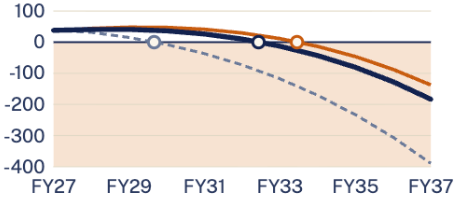
On the district’s own path, the closures buy one year. Reserves run out in FY34 with the closures and FY33 without them. The structural gap stays. We counted the closure savings generously ($3.3 million a year, including about 14 positions the district tied to the closures), and they still buy only one year.
There’s another route. A package of savings and revenue keeps schools open and keeps reserves above the board’s 90-day policy every year through FY37.
$2.3M
a year saved by closing two schools,
about 1% of the budget
1 year
is all it buys: reserves run out in FY34 instead of FY33
Our ask
Work through these options in public before any school closes.
What the model shows
Same district numbers.
Two very different outcomes.
Compare the corrected projections with the same scenarios after pulling the financial levers below.
Ending reserves, $ millions
- Base
- Interventions + SACC
- Both Schools Open + SACC
1 · The District's plan, adjusted for errors
2 · The same scenarios with all levers on
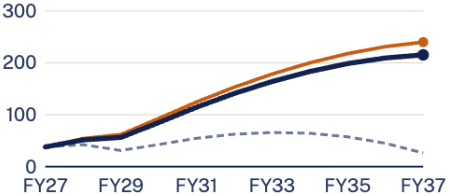
Model projections. Different vertical scales. Lines join saved annual balances; not observed results or audited forecasts.
Try it yourself
With every lever on, D65 never runs out and stays above the safety line all ten years. Without a referendum, the money lasts through 2037 but dips below the safety line after FY33. That’s why the model includes a referendum.
The levers
What’s in the model
Every financial lever on one scale, largest first. Each bar shows what the lever adds a year once it’s in place.
- Ask voters, with a plan they trust
- Spend carefully
- Use what already exists
| Lever | Size, per year | What it takes |
|---|---|---|
| Operating referendum from FY30 | Needs voter approval Nov. 2028. If packaged with the capital referendum, would be similar to 2017 referendum size adjusted for inflation. |
|
| Capital referendum from FY30 · bonds replace yearly building transfers | Needs voter approval Together with the operating referendum, the levy is about $22M in FY30. |
|
| Sustainable salary growth by FY32 | Needs bargaining Raises would still be comparable to other local districts. |
|
| Sustainable benefit growth by FY32 | Benefits are rising about 10% a year in the district’s plan. | |
| Teacher retirement savings by FY32 | About 12 teachers retire each year and are replaced at lower pay. | |
| West Evanston TIF extension for Foster debt from FY31 | Needs state law change State legislative approval. |
|
| Leaner central office by FY32 | 14 administrator and non-union support positions, phased in. No teaching positions. | |
| TIF money returning to schools from FY29 | Dempster-Dodge closing early (City recommends end of 2027) and Howard-Ridge expiring at the end of 2028. | |
| One time | ||
| Sale of Kingsley and Bessie Rhodes FY28 only | Midpoint of the district’s estimates. The administration advises using proceeds for buildings only; our model counts it toward operations. | |
The package clears the safety line by a wide margin, so it can absorb some pieces falling short.
Why a referendum, and why a plan comes first
Trust first.
Referendum second.
Every path that keeps D65 above the safety line for the long term includes a referendum, the district’s plan included. An independent poll shows a referendum would fail today (28% for, 41% against), and closing schools makes it harder to pass. Voters said what would change their minds: a long-term financial plan with clear spending limits. Our model shows how to give them that first, then ask.
A referendum today
28% for 31% unsure 41% against
Methodology
How we built the model
We started from the district’s projections (dated Aug. 26, released Oct. 13), which run through FY32, and extended each line to FY37 at its FY32 growth rate. We looked at what savings would be reversed from the district’s Interventions scenario if both schools were left open, which included the district’s $2.3 million in claimed savings plus some additional positions identified on October 26, to create three total scenarios: Base (No Action), Interventions, and Both Schools Open. Then we made a few corrections in every scenario.
- Capital spending. We corrected the $27 million error D65 has acknowledged in its building budget (capital spending counted twice), using D65’s own figure of $7.97M a year.
- Foster lease debt. We added $3.2M a year the projections left out. This adds cost.
- Missing revenue. We added the Ryan Field ticket surcharge ($250,000 a year from FY28) and Five-Fifths TIF revenue sharing (about $358,000 a year).
- SACC. Kept in every scenario, as D65 decided on Nov. 5.
Fiscal years end in June (FY34 is the 2033–34 school year). The board’s policy is to keep at least 90 days of spending in reserve.
Check our math
The model is available. Download the spreadsheet, switch any lever on or off, and change any assumption.
Found something we got wrong? Tell us at forabrighterevanston@gmail.com, and we’ll fix it in public.
The board deserves a better proposal. So do our kids.
Ask the board to work through these options with the community before any school closes.